Dropbears Selection Panel

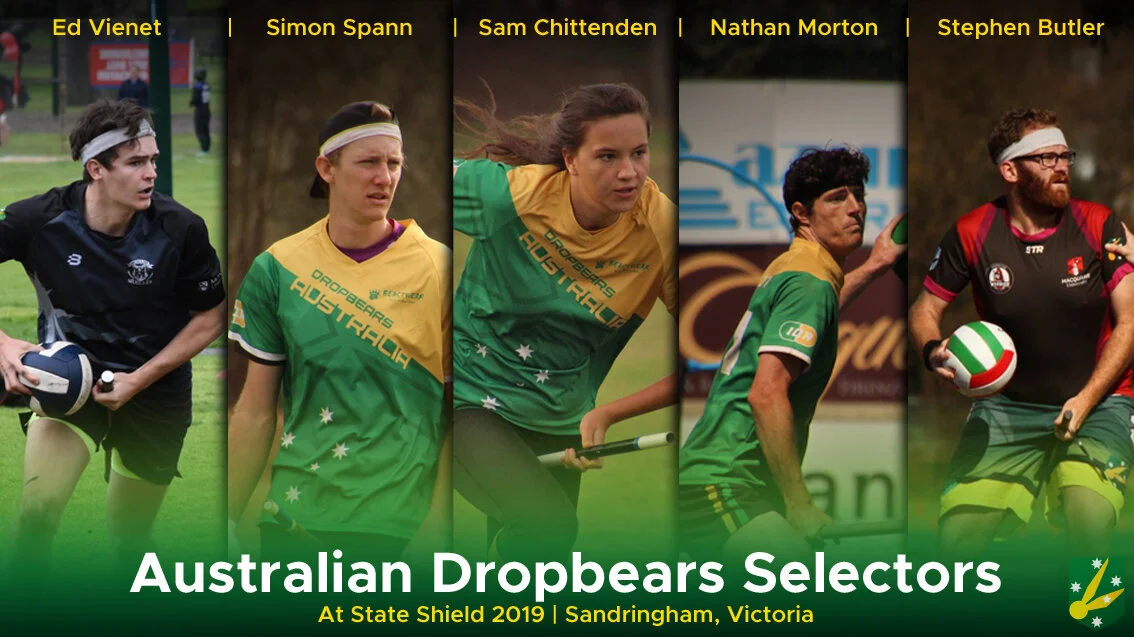
We are excited to announce the remaining members of the Australian National Quidditch Team Selection Panel, who will join the Head Coach Paul Harrison and Assistant Coach Luke Derrick in picking the Dropbears Squad for World Cup 2020.
Dropbears Selectors new.jpg

Original Photos: Ajantha Abey Quidditch Photography and Courtney Buckley Photography

Ed Vienet is currently affiliated with the Monash Muggles in Victoria, where he started quidditch in 2016, now playing his 4th season, having captained the team in 2017 and 2018, and led the team’s selection panel. He has played on the Victorian Leadbeaters since 2017, and was a selector for the team in 2018 and 2019. As well as being a Dropbear reserve in 2018, Ed also has an extensive sports background outside of quidditch, in bastketball, football, and netball. As a quaffle player, Ed’s focus is on defence, tackling, and wants to build a team that can win in 2020, and set up Australia to repeat in 2022.

Simon Spann hails from the University of Sunshine Coast Quidditch Club in Queensland where he started playing in 2014. Picking quidditch over being a national level sprinter, he played for the Dropbears in 2018 as a chaser and seeker, as well as advising the team as a fitness and conditioning coach. A certified athletics coach himself, Simon is looking forward to selecting a team with the dedication to reclaim the gold.

Samantha Chittenden began playing with the University of Sydney Quidditch Club in 2015, eventually becoming coach in 2016 and captain from 2017-18, and now moving on to coach the North Sydney Nightmares Quidditch Club this year. Sam has also been a member of the NSW State Team since 2016, a Dropbears reserve in 2016/18, and NSW selector in 2017/19. Between all the fantasy, club, and state teams she has selected and led, Sam boasts an impressive number of gold medals, and will be looking to add another to the tally at Richmond next July.

Nathan Morton's involvement in quidditch dates back to 2013 where he began playing with the Monash Muggles. Having attended every single QUAFL and every single Victorian tournament since then (bar Mudbash 2014), he has also been a member of and selector for the Victorian State Team since its inception and a member of the Dropbears squad in 2014, 2016, and 2018 (initially as a chaser, and more recently as a beater). Now playing for Willows Quidditch Club, Nathan's extensive experience and mastery of all positions will be of great utility in selecting the team who can reclaim the gold.

Stephen Butler is one of the most experienced selectors in Australia. Having started out with University of Western Sydney/WSQC in 2012, he has been involved as a selector for fantasy tournaments in all three major Eastern states for many years, with a number of medals to show for it. Now with Macquarie University Quidditch Club, Stephen has also been a selector for the NSW State Team since 2017. With many years involved in high level competitive quidditch, Stephen knows the attitude required of players in order to create a winning team.

Further information regarding Dropbears selection camps and training camps including a general timeline will be released shortly. Written applications for players will open next week.

Dropbears 2020 Leadership Team Announced:

We are excited to finally announce the first members of the Australian National Quidditch Team leadership, who will help organise, prepare, run, and lead the Dropbears to the 2020 Quidditch World Cup in Richmond, USA.

Dropbears-Coaches-and-Managers-copy.jpg

Paul Harrison has been selected as the Head Coach of the Dropbears for 2020. Originally of the University of Sydney Quidditch Club (Unspeakables) and then Macquarie University Quidditch Club, Paul has served as Head Coach of both of these teams, and now is playing his eight season with the Sydney City Serpents. Last year, Paul coached the NSW State Team to their first gold medal at Quidditch Australia's State Shield. As Head Coach, Paul will be responsible for the overall strategic vision and on field direction of the Dropbears as they try to reclaim gold at Richmond 2020.

Ruth Creffield has been selected as the Team Manager of the Dropbears for 2020. Playing for the University of the Sunshine Coast Quidditch Club since 2014, Ruth has been involved in her club's team committee for a number of years as well as being President of the Quidditch Association of Queensland, and playing for the Queensland Thunderbirds. As Team Manager, Ruth will be responsible for off field direction of the Australian Dropbears, including the planning of the trip to Richmond for the World Cup, looking after the administrative side of the team and facilitating a focus on team unity and player wellbeing.

Emma Luxford has been selected as the Assistant Manager of the Dropbears for 2020. She has been involved in the sport for almost eight years as a player and non playing member of the community with Blackburn Basilisks and more recently Melbourne Ravens Quidditch Clubs, and has over 25 years experience competing in and organising gymnastics. Em's extensive experience with large scale professional sporting organisation will be a great asset in her responsibility for assisting Ruth in the off field direction and management of the Australian Dropbears. Emma has since stepped down from this role.

Luke Derrick has been selected as an Assistant Coach of the Dropbears for 2020. He is currently in his eight year playing as a beater and keeper, having started out at the University of Sydney Quidditch Club and now playing for the Sydney City Serpents. Luke has been a coach and captain for both teams as well as playing for and captaining the NSW State Team. Luke has additionally been playing for the Dropbears in all of their international forays since 2014, being part of the World Cup winning squad in 2016, and Lead Beater Player in 2018. Luke will be responsible for assisting Paul in running training camps, and helping the Dropbears improve at the individual level and as a cohesive team.

Luke and Paul will both also serve as Selectors for the Dropbears squad. The rest of the selection panel will be announced tomorrow.

New Concussion and Injury Protocols for Quidditch Australia Sanctioned Games

Please be aware that as of today, the 15th of July 2019, Quidditch Australia is observing new Injury and Concussion Protocols, developed to increase player safety and in response to recent research surrounding brain injuries in contact sports.

Concussio-and-Injury-Protocols-copy.jpg

Original Photo Credit: Dammia Brosnan

The Concussion Policy stipulates that concussions are brain injuries that occur from knocks to the head or other parts of the body that may or may not result in a loss of consciousness.

Injury policies state that the Head Referee of a game holds duty of care, and should a referee team or medical team witness a potential concussion, the player concerned should be removed from play and tested with the SCAT5 Pocket Concussion Recognition Tool. Players exhibiting signs of concussion will not be allowed to resume playing, act as a speaking captain, or referee for the remainder of the day, and Quidditch Australia recommends 12 days before a return to play, in line with Rugby Australia's concussion policies.

Concussions that are ignored can be fatal. Players exhibiting signs of concussion should be referred to a hospital emergency department and further rules and recommendations regarding returning to play may be found within the policy document, including a Return To Play form that must be completed.

The Injury Policy stipulates the responsibilities and duties of care of all players, referees, medical teams, and tournament directors with regards to injuries and injury management.

Is it important that all teams, players, and officials understand these policies, and that they are implemented at all Quidditch Australia sanctioned games henceforth.

Quidditch Australia would like to thank Nic Radoll for his assistance and expertise in drafting these policies.

The Policy Documents may be found below or at www.quidditch.org.au/rules

Quidditch Australia Injury Policy 2019

Download

Quidditch Australia Concussion Policy (RTP Form included)

Download

Concussion Recognition Tool

Download

Volunteer Profiles: Manon te Riele

Quidditch is an entirely volunteer run sport. As nations around the world start and finish celebrating volunteers weeks, we are profiling some of the people from all around the country who help keep quidditch running. Manon te Riele is currently the Treasurer, Secretary, and Team Rep for South Melbourne Centaurs Quidditch Club, and Tournament Director of Melbourne Mudbash, one of the largest tournaments in Australia. Manon has been involved in quidditch admin and organising almost since she began in 2016, everything from social media to pitch managing, and an exceptional asset to the sport. Get a sense of what she does and why she does it below… 

IVW-Profiles-Manon-te-Riele-copy.jpg

What is your main volunteer role is at the moment? What does it involve?

My main volunteer role right now is Melbourne Mudbash co-Tournament Director. This involves organising the tournament, and working together with Nicola for all the planning and then running it on the weekend itself. It includes background things like organising sign up, equipment, volunteers and mending snitch shorts and the fun things like scheduling, having 2-way radios and running purely on adrenaline for the entire 2 days of the tournament.

My more permanent quidditch volunteer job is as secretary/treasurer and team rep for my club, South Melbourne Quidditch Club. There I do all the behind the scenes admin so our brilliant captain, Mark Kelly, vice captain Justine Herring, and the rest of the team can train and play at their best. This involves ensuring people are signed up, uniformed, have equipment and a good social event every once in a while, and actually show up at games. It also involves planning all aspects of our yearly trip to QUAFL and promoting all QA and VQA activities to try and get people participating in those.

What’s the rest of your history in quidditch?

I’ve been playing quidditch since 2016, when I started uni and had just moved to Melbourne. I did the social media for our team in 2017. I tore my ACL and had a knee reconstruction that year which meant I couldn’t play quidditch for a season. Instead, I got involved pitch managing at Mudbash and Vic Fantasy, and generally managed and helped out with my team.

In 2018 I was back playing and I was Assistant TD for Mudbash. Inmy club I became secretary/treasurer and Minotaurs team rep in 2018 when we hadtwo teams and kept the roles when we moved back to one team this year.

I volunteered a little on merch for QUAFL 2017 and 2018 but wasalso very busy getting my own team together at last QUAFL. I did sometranslating for Quidditch Nederland in 2017/2018 as well, which was superinteresting.

What makes you passionate about quidditch and want to volunteer?

I’ve been a massive Harry Potter fan since I was 10 so playingquidditch was just an extension of that at first, but I’ve stayed because Ilove the community, have made fantastic friends here and it’s a fun physicalchallenge.

I get quite invested in everything I do so volunteering for asmall role that needed doing was obvious at first. As I’ve learned more andgotten experience, I found myself taking on bigger challenges because I reallyenjoy seeing something come together and having people enjoy something Icreated for them.  

What's the hardest part of volunteering?

It takes a lot of time around a big event and the least fun partsare usually when you’re at a computer by yourself doing admin or nagging peopleto sign up for things because time is ticking.

What's the most fun part of volunteering?

The really corny answer is working with and meeting new people, gettinginspiration from others and learning new skills. I really enjoy the wholeplanning part- organising, working with people to make something really cool,having things come together and then enjoying what you created with yourfriends.

Are there people who have inspired you?

I learned most of what I know about organising a quidditchtournament from Nicola Gertler and could never dream of living up to everythingshe does for and knows about quidditch.

I am constantly inspired by those in my team who spend hours on strategy and preparation for games and training. Mark, Justine, and Emma ('Jandals') Humphrey are our current fearless leaders but their predecessors, James Brooks and Michael 'Dundee' Braham created a fantastic foundation and balance of serious competition and fun. It gives me a great reason to keep doing what I do to support them and help ensure their visions happen.

In terms of team rep and team organisation, I learned a lot fromCarissa Dyall who had played quidditch for many years before me and took on alarge volunteer role in our team when she played- nowadays she’s there for meto give ideas, support and encouragement.

Why should people get more involved in quidditch volunteering?

It’s really fun! You feel that you did good things and you get tohelp the sport grow. I always feel such a strong sense of community when I’minvolved in volunteering, which keeps me coming back.

Using your life/work related skills for quidditch is also verysatisfying, it’s a fun thing to put on CVs and guarantees you sound interestingin job interviews.

These profiles are being conducted in coordination with Q Consultancy, an international quidditch organisation who this week, is compiling volunteer profiles from all around the world, in time for Volunteers Week in the UK. Read more profiles here.

Volunteer Profiles: Mark Kelly

Quidditch is an entirely volunteer run sport. This week, as nations around the world start and finish celebrating volunteers weeks, we are profiling some of the people from all around the country who help keep quidditch running. Mark Kelly is currently the President of the Victorian Quidditch Association, but he's been volunteering in quidditch for many years in commentary and analysis, both within Australia and overseas! Mark has covered everything from Vic League Games and State Shield to the Quidditch World Cup, and was even called in as an expert analyst at the European Quidditch Cup 2019. Get a sense of what he does and why he does it below…

IVW-Profiles-Mark-Kelly.jpg

What kind of things do you have to do as president?

The role, week to week, is mostly making sure things are tracking smoothly, solving any problems that come up, and managing other VQA members and volunteers. At first I was intimidated, not knowing what to expect, but in practice it has been pretty straightforward, and any time a problem comes up the rest of the exec are always there to hash it out.

What's the hardest thing about being president?:

The hardest part is probably covering multiple roles when short handed. Many hands make light work, but it can get tricky to juggle everything when we don't have enough people pitching in.

What's the most fun part of being president?

There's something really rewarding about working together with people towards a common goal and shared passion. Really, that's what I most enjoy about volunteering in general, and especially in quidditch.

Are there other ways you've volunteered in quidditch?

Definitely! I've worked on the live stream teams at several State Shields, as well as at World Cup in 2018! Engaging with the stream, doing in-game commentary, post-game analysis, and generally helping to keep the stream following smoothly. It was a fantastic experience and I'm planning to go to the US for World Cup 2020, to do it again!

Why should more people get involved in quidditch volunteering?

I've really loved the volunteering I've done with quidditch, there's just such a strong sense of community when people work together on something they all care about. It's such a rewarding experience and I highly recommend people to jump in and get involved!

These profiles are being conducted in coordination with Q Consultancy, an international quidditch organisation who this week, is compiling volunteer profiles from all around the world, in time for Volunteers Week in the UK. Read more profiles here.

Volunteer Profiles: Kathryn Cooper:

Quidditch is an entirely volunteer run sport. This week, as nations around the world start and finish celebrating volunteers weeks, we are profiling some of the people from all around the country who help keep quidditch running. Kathryn Cooper is currently the Chairperson of Quidditch NSW (QNSW), but she started her quidditch journey all the way back in 2013 with the University of Sydney Unspeakables. Since then, she's been a manager, vice president, coach, captain, team mum, and inspiration to many. Get a sense of what she does and why she does it below...

IVW-Profiles-Kathryn-Cooper-copy-1.jpg

What kind of things do you have to do as chairperson of a quidditch governing body?

Since becoming Chairperson of Quidditch New South Wales earlier this year, I have to complete a number of tasks, some of which are ongoing throughout the year. Mostly, I just have to make sure that I am communicating with the Club Representatives of the clubs within New South Wales about what the Board is planning, and overseeing much of what is occurring within the New South Wales community (I am an admin of five different Facebook groups or pages for Quidditch New South Wales). Part of this means working with the other Board Directors, Phillip Vankerkoerle and Geoffrey Talbott, to make sure that the New South Wales Quidditch League (NQL) tournaments are being organised fully, and also coordinating with the other volunteers in the New South Wales community, making sure that the tasks we set for them are being completed, or that they are getting the support they need to organise and coordinate their own plans and ideas for Quidditch New South Wales. Recently, I have also been working with the New South Wales State Shield Team Selectors to coordinate the tryouts, and that they have everything they need to select the team.

What’s the hardest part of your job as chairperson?

I would say that the hardest part of being Chairperson is that there are fewer members of the Quidditch New South Wales Baord this year, and that myself, Phillip, and Geoffrey are all having to take charge of multiple portfolios. For 2019, I am also in charge of the Events portfolio. This is quite a lot of work to do, and with this also being my first year as a Board Director, there is a lot of pressure to make sure that everything is working well.

Are there other ways you volunteer or have volunteered in the past for quidditch?

This is actually quite a long list, as I have been somewhat volunteering in different roles since I joined the University of Sydney Quidditch Club in 2013. For the six years that I was part of that club, I held six different leadership roles. Since moving on and joining Valkyries Quidditch Club this year, I have also taken up leadership roles within the club. On top of holding these leadership roles, I have helped coordinate and run multiple fantasy tournaments throughout the years, mostly the Internal Fantasy tournaments that the University of Sydney Quidditch Club have run in the last few years, of which I have also been the Tournament Director. Last year, I also volunteered as a commentator for the State Shield tournament, which my first official outing as a quidditch commentator. I have continued commentating this year, by being a commentator for NQL matches this year, and helping support Arfy Papadam in running QNSW TV this year.

Why do you volunteer in quidditch?

I have always enjoyed helping organise events and tournaments, even before I joined quidditch. Within the last few years, I have definitely taken more of a role in helping organise bigger events, rather than just smaller club-based events, and I think this mostly comes down to wanting to help further the development of quidditch within New South Wales. I want to be able to help others with the ideas that they have, and what they are able to do to help improve how events and tournaments are being run. A lot of this mostly just comes from wanting to make sure everyone is being looked after, and that they are getting the support they need to do what they can do.

What’s been your best experience volunteering with quidditch?

I don’t really have one specific experience with volunteering that I would say is my best experience, but rather I have just enjoyed helping and supporting others to achieve their goals within quidditch. Whether this just be making sure that tournaments are being organised, or that issues are being handled, I just like making sure that they are able to do the best they can do. That might be how I achieved the persona and nickname of Mum when I was still part of the University of Sydney Quidditch Club, and that this image has evolved and grown within the New South Wales community.

Why should people get more involved in quidditch volunteering?

Being a volunteer within the quidditch community has been really rewarding, and has meant that I’ve been able to meet many people, and get to know their own experiences with quidditch volunteering. We all have different ways that we have volunteered, and it’s really interesting to hear the different ways that we have all helped quidditch growed. If anyone has any idea that they want to see happen within quidditch, then they should definitely give a try, because it could end up being an amazing idea that could really help the growth and development of quidditch. I would encourage anyone in the New South Wales community to do this, as myself and the other Board Directors would hear the ideas that you have, and how you would like to see them happen.

These profiles are being conducted in coordination with Q Consultancy, an international quidditch organisation who this week, is compiling volunteer profiles from all around the world, in time for Volunteers Week in the UK. Read more here.

QUAFL 2019 to be held in Minto (NSW), December 7-8th!

49371760_2163840400327773_6882127484825894912_o-MM.jpg

Quidditch Australia is excited to announce the dates and location for the Australian National Championships, QUAFL 2019!

The tournament will be held at Kayess Park in Minto, on the weekend of the 7th and 8th of December. Quidditch Australia will be cohosting the tournament with Macarthur Weasleys Quidditch Club, who have successfully hosted two editions of their own Macarthur Fantasy Tournament, as well as a number of NSW Quidditch League days with much general acclaim. The fields here have been used for quidditch tournaments before, have ample space, are able to facilitate line marked pitches, and are an easy 45-minute train ride from Sydney, with a variety of nearby accommodation available as well.

Plans are in the works for putting on various workshops, expo games, and even bring back wheelchair quidditch in the days leading up to the tournament.


All gameplay policies regarding QUAFL including team and player eligibility, referee requirements, etc., can be found in the 2019 Gameplay Policies document, able to be found here. More information regarding accommodation options, tournament format, team and player sign ups, tournament fees, and other relevant details will be forthcoming in the next several weeks as we continue to pin down the details.

For now? Save the date!

Australian Dropbears Coach, Assistant Coach, Manager and Selection Panel Applications now open!

Applications for the Head Coach, Assistant Coaches, Team Manager and Selection Panel members are now open, and will close at 11:59pm on June 23th 2019.

A full breakdown of the Head Coach, Assistant Coach/es, Team Manager and Selection Panel positions and their associated responsibilities can be found outlined here.

Dropbears-Coach-Manager-Selector-Applications-copy-2.jpg

Head Coach

Required non-playing role

The head coach is responsible for the overall strategic and on field direction of the Australian Dropbears.

Assistant Coach/es

Intended non-playing role

The role of the assistant coach or coaches is to assist the head coach in the development of the strategic and on field direction of the Australian Dropbears, as well as providing athletes with support and personalised training. With the intent to have two assistant coaches, the role has been broken up into a quaffle and bludger focus as two dominant aspects of the game. This is a guide only and applicants are welcome to put forward their own focus areas in their application.

Team Manager

Required non-playing role

The team manager should set the off field direction of the Australian Dropbears, including the planning of the trip to Richmond for the World Cup, looking after the administrative side of the team and facilitating a focus on team unity and player wellbeing.

Selection Panel Member

Intended non-playing role, but open to players

The selection panel is responsible for the selection of the team, in conjunction with the coaching team. The selection panel members are required to attend all national selection based sessions, state shield, and any pre-national selection events held in their own state. Once the squad is selected, the panel will hand the responsibility of the team over to the coaching team and team leadership.

The selection panel will be made up for five to seven individuals, inclusive of the coaching staff.

Applications are open for all positions to those who do and do not intend to apply as players for the Australian Dropbears as Quidditch Australia wishes to encourage a wide pool of applicants, however applicants may be given preference for roles if they not intend to try out as a player to avoid potential conflict of interest within the process.

APPLY NOW

State Shield Eligibility, Rules, & Regulations

ELIGIBILITY

All players must be full members of Quidditch Australia (QA) to be able to participate in the tournament.

State team eligibility is determined by the following clauses. You are eligible for a team if you meet any of the following:

  1. You currently play for a club from that state and commenced playing in that state from no later than the beginning of the current season;

  2. You currently live in that state;

  3. The team that you first played quidditch for is from that state;

  4. You spent the majority of school (K-12, at least 7 years cumulative) in that state.

If you have different states for each of the above criteria, you may choose which team you wish to apply for.

If you have moved states after the commencement of a season and do not meet any of the above criteria for that state, you may not apply for that state. You may however apply for the state you previously moved from, given you meet the above criteria.

A season is defined as the commencement of a club based state league.

Once you are chosen to represent a state as either a player or reserve, you forfeit your eligibility based on clauses B, C, and D. For example, consider a player who grew up in Melbourne spending all of their schooling there, then went to NSW for university and began playing quidditch there. If they choose to represent NSW this year, they may only play for NSW in future years until they play for a club team in a different state under clause A.

Withdrawing your application or failure to make the state team you applied for does not forfeit your eligibility to apply for other teams. You may apply for multiple states, however you must withdraw all but one application upon selection. For example, you cannot be a reserve for one state and a player for another.

All criteria from above regarding previous participating for a state applies from 2018’s State Shield onwards.

ROSTERS

Rosters must be submitted in the following format:

21 Players

9 Reserves

Staff (see below)

Rosters must list a player’s full name, jersey number, and gender.

Each team is permitted a maximum of 12 players on the final roster submission who identify as the same gender.

The deadline for preliminary rosters, maximum 30 individuals, shall be due on 1 September 2019. No new players may be added after this point.

Preliminary rosters aim to allow QA to begin marketing the event to the wider quidditch community and general public.

A final roster of 21 players must be submitted by 5pm Thursday prior to the commencement of the QA State Shield. Final rosters allow for movements between reserves and players submitted in the preliminary roster.

For states with more than one team, reserves are allowed to be listed from the players on the state’s secondary team for their primary team. In the case that a player moves up from the secondary team to the primary team, a player from the primary team may not move down to the secondary team. The reserves for the secondary team may not be players listed on the primary team’s roster. This system operates in the same manner for states with a third team, and so on.

TEAM STAFF

Each team is welcome to have up to 4 non-playing individuals on their subline during gameplay in the following roles:

  • Coach

  • Assistant Coach

  • Team Manager

  • Sports Trainer

These staff positions should be listed on the preliminary roster and can be adjusted up until the final roster submission.

The conduct of team staff is governed the the IQA Rulebook 2018-2020 section 1.1. LEADERSHIP AND TEAM STAFF.

RULES & REGULATIONS

The 2019 QA State Shield shall be governed by the QA Gameplay Policies. Participation in the event by players, staff, officials, tournament organisers, and spectators is governed by the QA Code of Conduct, Membership Protector Policy, and Constitution. Actions which violate the regulations laid out in these documents may result in suspension or disqualification from the event at the decision of the tournament committee and QA Board of Directors.

Instances of disputed games are governed by the Disputed Games Policy.

The 2019 State Shield shall use the 2018 - 2020 IQA Rulebook with QA amendments.

MEDIA

Plans surrounding the public release of rosters and staff are to be communicated with the QA Media Director (media@quidditch.org.au) for branding purposes.

Internal Leagues Resume: USQL and USCQL

Australia fields two internal club leagues - the University of Sunshine Coast Quidditch League (USCQL) which has been running for many years now, and the University of Sydney Quidditch League (USQL), which has been running since last year.

Both enter 2018 significantly changed, and have started off their respective seasons with one round a piece. We recap below:

53582148_1248472285303281_8250338129270013952_n.png

The USC Quidditch League

After running for almost five years without changing teams, USC finally saw fit to change things up, reshuffling their four teams - Phoenix, Nargles, Thestrals, and Death Eaters, for the first time since the league's inception. This was broadly seen as a good change, as it's allowed the league to re-balance teams, stop some teams becoming over dominant, and make the whole competition more fun and a better learning experience for everyone, which is typically the main aim of such development focused internal leagues.

At the end of the first round of games, the Death Eaters sit on top of the USCQL ladder with a win over Phoenix 120*-40, and a narrow win over Nargles 90*-70. Nargles currently sit at second, with a strong win over the Thestrals 170*-30, while Phoenix was also able to narrowly defeat the Thestrals 80*-40. With half the games in range and much more parity between teams, it will be exciting to see how the rest of the season pans out.

Amy Pistorius, of team Phoenix, and new player for USC, said of the tournament:

"USC's quidditch team is the most inclusive and energetic team sport I have ever had the privilege to be a part of! The first few games on Wednesday night were absolutely epic, spirits were high, and everyone gave it their all to ensure a brilliant start to the season"

Internal leagues have been incredibly valuable to the development of new players in USC and USYD, and a part of the two clubs' success over the past years - something that is clearly continuing in 2019.

53212917_2085454234836134_6765842413517799424_n.jpg

The USYD Quidditch League

The USQL has also seen a change up from the five sparse teams of 2018 to a now four team league (RIP Fisher Firenze). The USQL places a particular emphasis and focus on new players, and especially putting relatively new faces into the positions of captain, with this year all the team captains (introduced in this adorable and brilliant Brooklyn-99 style video) joining the sport in the last two years. The league is also permitting older players who have since moved on from the club to continue to participate in games, if they played in USQL previously, and as such, it's become a great space for old and new to mix under the new directorship of Ashan Abey.

The first round of the USQL held earlier in March was only a trial, to assess team balance and give new players a free taste of the sport, but none the less, despite the cold and miserable conditions, it was a successful day, with four of the five games being played in range (one going to double over time!), both Werewolves and Veela coming away with two wins and everyone having a lot of fun.

Shivanee Gopal, a new player for USQC, said that

"playing quidditch for the first time with the USYD team was definitely a fun, challenging, and unique experience!! Playing alongside and learning skills from experienced and supportive team members made it all the more memorable."

shivanee.jpg

Shivanee Gopal catching her first snitch in the first USQL game of 2019 for Werewolves against Veela, to win the game 80*-60 | Photo: Ajantha Abey Quidditch Photography

Matthew Phang, another new player, also came away with a positive attitude, even despite a shoulder injury:

"USQL was an amazing experience! It was super chill and a great way to get into playing quidditch as everyone was so supportive. Everyone got to play what they wanted, and overall it was great fun!"

It is fun to note that then brand new players interviewed in last year's coverage of the first USQL of the year (Julia Baker and Taylor Angelo) can now be found captaining the Abercrombie Aurors and USYD Unbreakables respectively, as well as both acting as Media and Communications officers for the club executive. Who knows that the future holds for the players joining this year's league.

Teams are not yet set for the USQL, the first proper fixture for which is set for April 14th. Whatever the outcome of the two leagues, the players they produce will be worth watching over the season and years to come.